Cage & Mirror Publishing
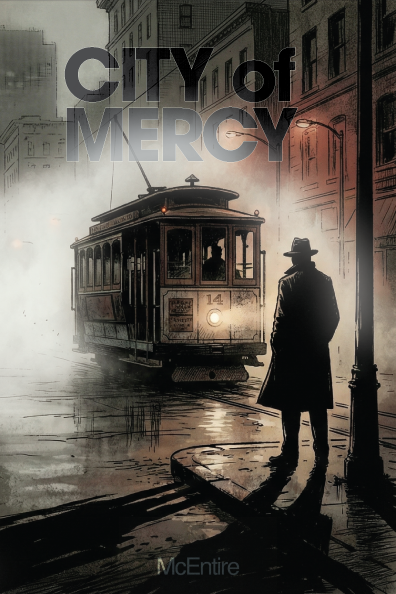
City of Mercy
A novel by Jeremy McEntire
The fog hadn't lifted by noon, which meant it wouldn't lift at all.
Book Details
- Publisher
- Cage & Mirror Publishing
- Genre
- Mystery Noir
- Setting
- San Francisco, 2024–2025
- Paperback
- 979-8-9949685-4-3
- eBook
City of Mercy is a mystery noir thriller set in San Francisco's Tenderloin — fifty square blocks containing sixty percent of the city's homeless population, a billion-dollar crisis that never improves, and a killer who understands both facts better than anyone.
The Premise
A serial killer is targeting homeless people in the Tenderloin. The victims are found positioned with care — arms extended, palms up, fingers slightly curled. Like they were waiting to receive something. Like they'd been arranged for an audience that wasn't there.
Detective Tom Walsh, who worked these streets early in his career, returns as lead investigator. A journalist with deep knowledge of the homelessness beat is writing profiles that humanize each victim, creating a wave of public empathy the city has never managed. An FBI profiler arrives — not the A-team, because homeless victims don't warrant the A-team. And somewhere in the background, a quiet force is reshaping the city's response to its longest-running failure.
The murders are methodical. The positioning is deliberate. The city is changing. And these facts are more connected than anyone realizes.
What This Novel Is
City of Mercy is a fair-play mystery. Every clue is available to the reader. The satisfaction is not in a twist you couldn't see coming — it's in the slow, sickening recognition of what was always in front of you.
It is also a novel about systems. About why a city that spends $846 million a year on homelessness has more homeless people than when it started. About the gap between intention and outcome, between legitimacy and effectiveness, between what institutions promise and what they deliver.
The mystery is the vehicle. The question it carries is harder than whodunit:
Why does society forgive institutions that kill through process while condemning individuals who kill through action?
The Characters
Detective Tom Walsh
Weary, Catholic (lapsed), professional. Worked the Tenderloin for five years early in his career. Now returned as a specialist. Narrates from ten years after the events — a memoir frame that creates haunting retrospective distance. He knows more than he says. He's not sure what he knows is enough.
Kate Murphy
San Francisco Chronicle reporter covering the homelessness beat. Former lover of Walsh. Her profiles of the victims are creating the empathy response the city never generated on its own. She doesn't yet understand where her source material is coming from.
Dr. Rachel Ward
FBI profiler. Young, competent, assigned to this case because the A-team had higher-profile work. Imposter syndrome meets a case that demands religious literacy she doesn't have. Her profile is accurate. Her application of it is not.
Father Daniel Reyes
Associate pastor at St. Anthony's. Grew up poor in the Mission. Seminary was escape. Uses contempt as a defense mechanism against reminders of what he escaped. He is not who the investigation thinks he is, but what the investigation uncovers about him is real.
The Setting
San Francisco, 2024–2025. The Tenderloin at ground level — SRO hotels, the dish station at St. Anthony's kitchen, alley crime scenes in fog so thick a man could become a shape, then a suggestion, then nothing at all.
A city that holds meetings about a problem it has spent forty years not solving. A political landscape where the mayor is reform-minded, the DA is tough-on-crime, and the moderate board majority creates just enough political opening for something to change — if something forces the change.
From the Book
"The fog hadn't lifted by noon, which meant it wouldn't lift at all. Tom Walsh stood at the corner of Turk and Jones and watched it hang between the buildings like something that had given up. Not moving, not burning off, just sitting there in the gray space between the rooftops and the street, turning the Tenderloin into a city of soft edges and uncertain distances. A man could disappear in fog like this. A man could become a shape, then a suggestion, then nothing at all."
"His arms were extended from his sides, palms up, fingers slightly curled. Like he was waiting to receive something. Like he'd been arranged for an audience that wasn't there. His expression was peaceful. That was the word that came to Walsh's mind, though he pushed it away as soon as it arrived."
"The city spends eight hundred million dollars a year on homelessness. Eight hundred million. And there are more homeless people now than when they started. Maria Santos fell through six different cracks before she fell into a doorway on Eddy Street. The killer didn't create those cracks. The killer is just using them."
"The people who do this work, who really do it, year after year — we all carry something. Frustration. Anger. You can't watch people die slowly, day after day, and not feel something dark sometimes."
Sample Chapter: Chapter One
The fog hadn't lifted by noon, which meant it wouldn't lift at all.
Tom Walsh stood at the corner of Turk and Jones and watched it hang between the buildings like something that had given up. Not moving, not burning off, just sitting there in the gray space between the rooftops and the street, turning the Tenderloin into a city of soft edges and uncertain distances. A man could disappear in fog like this. A man could become a shape, then a suggestion, then nothing at all. Walsh had seen it happen. He'd watched people step off curbs into that gray and simply cease to exist, swallowed by the city's breath, gone until the weather changed or they weren't.
He lit a cigarette. He'd quit three years ago, but the pack had been sitting in his glove compartment for six months, waiting for a day like this. The first drag was harsh, chemical. The tobacco was stale enough to taste like something other than tobacco. He smoked it, anyway. The air was cold and wet against his skin, and the cigarette gave him something to do with his hands.
He hadn't been to the Tenderloin in ten years. He'd spent five years here before that—not behind a desk, not in a car, but on foot, walking these blocks every morning on the outreach beat. Checking doorways. Learning names. Watching the same faces age ten years in two. He'd been twenty-six when they assigned him there, still believing the work would accomplish something. He'd been thirty-one when he put in for the transfer. By then, his notebook was full of names that were no longer attached to living people.
The neighborhood hadn't improved.
The storefronts along Turk looked the same, but different—same iron bars on the windows, same faded awnings, but the businesses behind them had changed in ways that told a story he didn't want to read. The corner market where he used to buy coffee was a nail salon now, its windows papered over with sun-bleached posters advertising specials in a language he couldn't read. Vietnamese, maybe. Or Cantonese.
The neighborhood had always been a palimpsest—each generation's needs written over the last, never quite erasing what came before. He could still see the ghost of the old sign underneath the new one, faded letters that said Grocery & Sundries, a promise from a time when grocery stores sold sundries and people still used words like that.
The check-cashing place next door had become something called a "wellness center," even though its door was propped open with a cinder block and a woman in a hospital gown sat on the threshold. She was rocking slowly, and her bare feet were black with street grime. She was singing something. Walsh could hear her song when the traffic lulled. It was a melody that might have been a hymn or might have been nothing, just sound escaping from a throat that needed to make sound. Her feet were bleeding at the heels. There were bright smears on the concrete where she'd walked.
Three doors down, a new business had opened, with a sign that said Harm Reduction in clean sans-serif letters. The font was expensive. The building was not. A young man in a fleece vest stood outside, handing something to a skeletal figure Walsh couldn't quite see in the fog. Their hands met, passed something between them, parted. The skeletal figure shuffled away, hunched against the gray, already disappearing. The young man in the fleece vest made a note on his phone and waited for the next one.
Walsh watched this transaction without interest. He'd seen versions of it before. The city's attempts to manage its failures had gotten more organized over the years, more professional. There were apps now. There were metrics. There were people in fleece vests tracking interventions on their phones. None of it seemed to make any difference except to the people who got paid to pretend it did.
But the pho shop on Eddy was still there. Walsh could see it from where he stood. It had the same hand-painted sign, the same steam-fogged windows, the same woman behind the counter he'd bought lunch from three times a week for five years. She'd been old then. She was ancient now. The restaurant had outlasted three recessions, two pandemics, and whatever the Tenderloin had become in his absence. Some things just refused to die.
The smell hit him. He'd forgotten it, or he'd made himself forget, the way you forget pain once it's over, the way you convince yourself that it wasn't that bad because the alternative is admitting you'd spent five years breathing it.
Urine and rot and something sweeter underneath, something chemical that caught in the back of his throat and stayed there. The Tenderloin had always had its own smell—a geography of odors that shifted block by block, doorway by doorway, as precise and specific as any map. Here, at Turk and Jones, it was human waste and fentanyl smoke and the funk of bodies that hadn't been washed in weeks. That last one was the hardest to describe. It wasn't just dirt, or just sweat, but something older, something that happened when skin stopped being cared for and started being endured. He'd smelled it on his father at the end. He breathed through his mouth now and felt his stomach clench anyway.
A shopping cart rattled past. Walsh stepped aside without looking—you learned that reflex down here, the automatic sidestep that kept you out of someone's path without making eye contact, without inviting conversation or confrontation. Eye contact was currency in the Tenderloin. It meant something. It acknowledged existence, and acknowledging existence created obligations that neither party could afford.
The cart's wheels caught on a crack in the sidewalk, and its owner cursed softly, a string of words that might have been English or might have been something else entirely. Russian, maybe. There had been Russians in the Tenderloin when Walsh worked there, old émigrés living in the SROs, collecting disability and drinking themselves quiet. He wondered if any of them were left. He wondered if this was one of them, grown older, grown invisible, grown into the landscape like a tree that nobody noticed anymore.
He passed a doorway he recognized. 411 Turk, the recessed entrance to an SRO that had been condemned since before he'd left. A flash behind his eyes: a man named Jimmy Sato, cross-legged in this doorway every morning for three years. His sleeping bag was folded neatly beside him, his coffee thermos from the church was balanced on his knee.
Walsh used to bring him a danish from the pho shop on Tuesdays. They'd talked about the Giants, about Jimmy's daughter in Sacramento who didn't return his calls, about whether the weather would hold. Then, one Tuesday the doorway was empty and the sleeping bag was gone and nobody at the station knew where Jimmy went. Walsh found out two weeks later—county morgue, exposure, unclaimed. He'd been the one to call the daughter. She hadn't cried. She'd said thank you for letting me know in a voice that sounded like a door closing.
He didn't turn to look. He was watching the crime scene tape flutter at the mouth of the alley ahead.
There was yellow tape, the standard issue, the same tape they strung around car accidents and murders and any place where normal life had to stop for a while. It moved in a breeze Walsh couldn't feel, snapping against the bricks of the alley entrance like a flag declaring territory. Behind it, shapes moved: uniforms, plainclothes, going about a job none of them wanted.
Walsh finished his cigarette and ground it out against a parking meter. The meter was broken. Its display was dead, its coin slot was plugged with something hard and gray. He dropped the butt into the slot anyway. It fit.
The uniform at the tape was young. Mid-twenties, with a fade that looked more military than sharp. Walsh didn't recognize him, which meant he'd come up after Walsh left. The kid had that look, that tightness around the eyes, the skin pulled taut, the blink rate wrong. He had been standing too long in a place like that, seeing things one couldn't un-see, smelling things that would forever be committed to memory. His hand rested on his service weapon, touching it for comfort. Walsh had done that too in his first year. Then, he'd stopped. Then, he'd started again.
"Inspector." The uniform nodded him through, one professional acknowledging another. "They're behind the building. Alley runs between the SRO and the old hotel."
"Who's primary?"
"Sergeant Okoro. She's with the body."
"How long have you been on the tape?"
"Since 7 am, sir. About four hours."
Four hours standing at the mouth of an alley in the Tenderloin, smelling what this kid was smelling, seeing what this kid was seeing. Walsh nodded and didn't say anything else. He ducked under the tape.
The Weight of It
This is not a comfortable novel. It is designed to make moral certainty impossible. The mystery resolves. The larger question does not.
The reader will close the book thinking — not satisfied. That discomfort is the entire point.